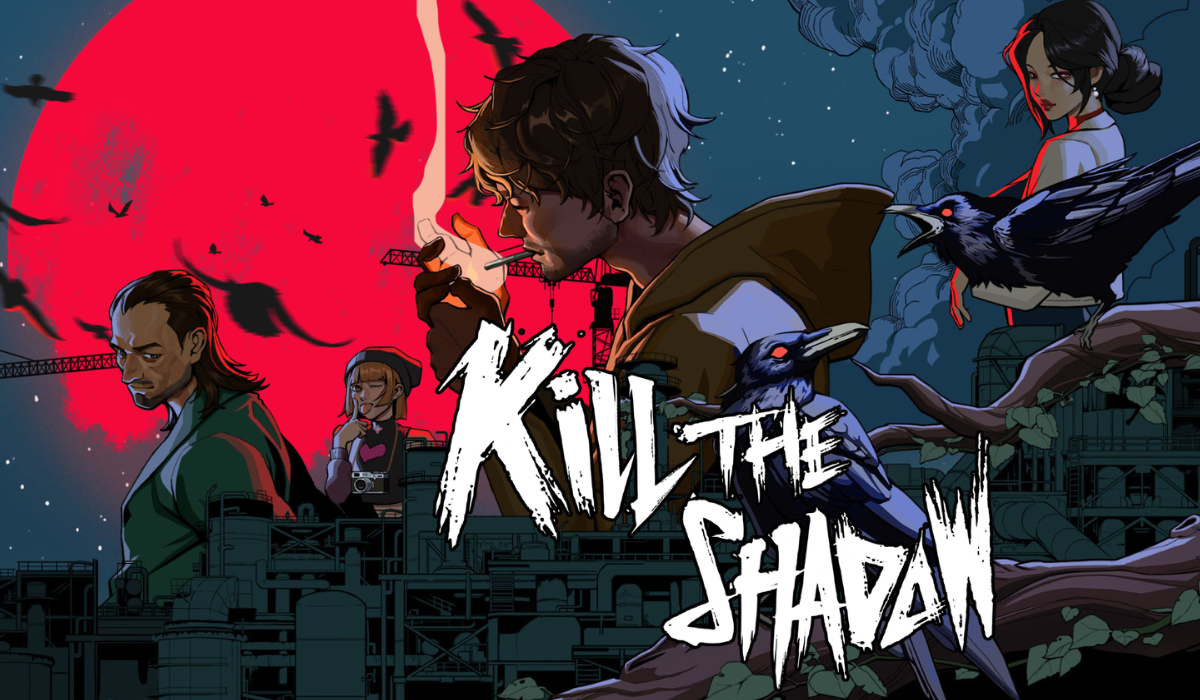
Lucas was once a promising detective, but ten brutal years have dulled his senses. Returning home in Kill The Shadow, he finds a world he doesn’t recognise and now must re-find his skills as he helps an old colleague solve a mysterious disappearance. He won’t be alone, though, as a somewhat mysterious and maybe supernatural entity has tagged along.
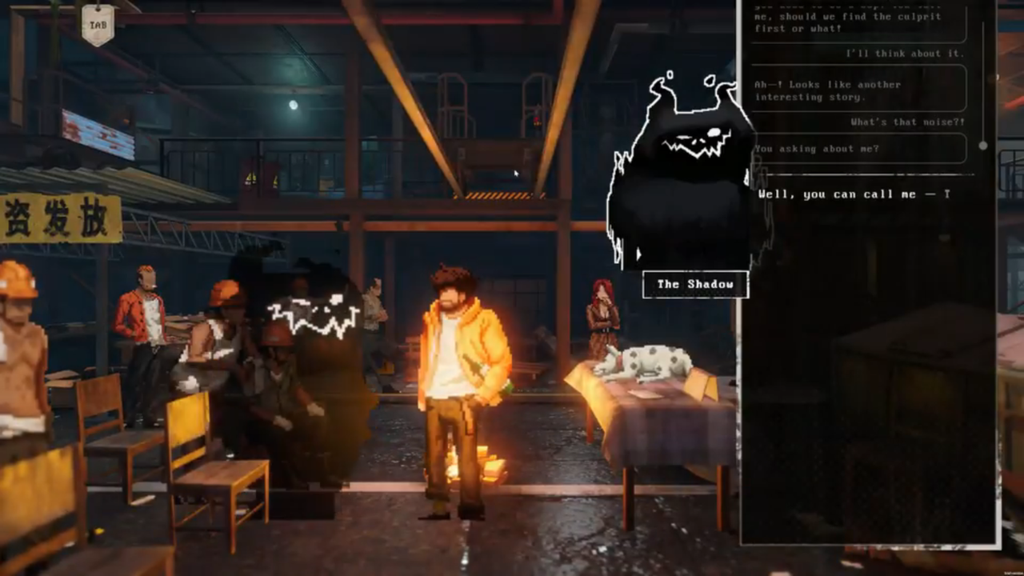
The Investigation starts..
Kill The Shadow is, at its core, a detective adventure with some elements of point-and-click adventures. Lucas’s journey switches back and forth over the span of ten years as seemingly unrelated cases culminate into a present-day conspiracy. The world is an alternate-history China, divided by war into North and South provinces. One is under strict Imperial rule while the other is ruled by wealthy families and gangs.
The opening, which serves as a tutorial, is set in a factory in the North, where Lucas has been stranded for ten years, trapped there when the conflict arose. He has finally earned enough to cross the border, only for a catastrophe to prevent it. Lucas tries to investigate and is then visited by an entity known only as “The Shadow” whom only Lucas can communicate with. The Shadow can help Lucas rewind events like a VHS tape if he collects enough clues to help piece together the facts of a case.
Dark Tide City
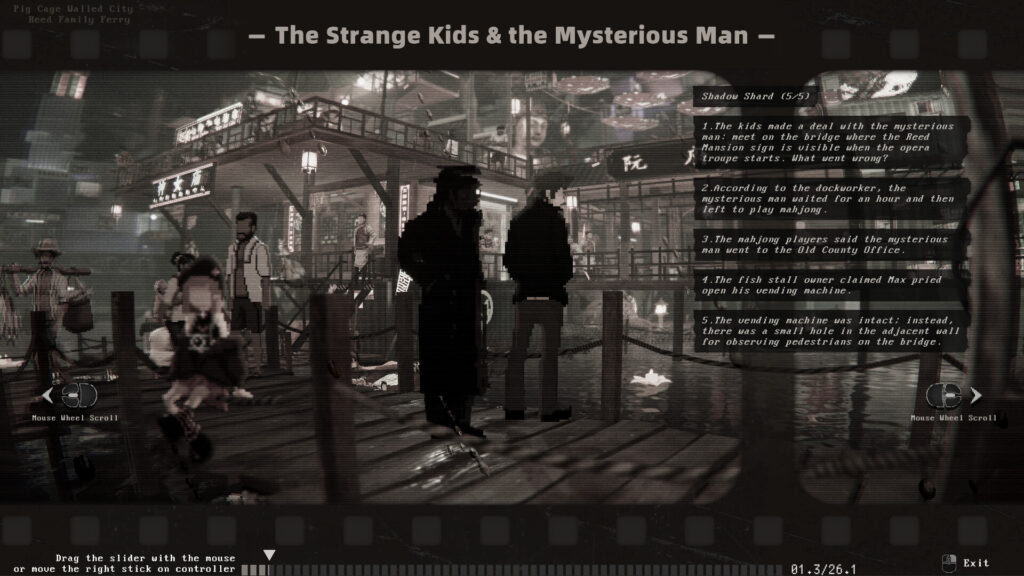
Moving forward, Lucas finds himself in the Southern Dark Tide City, a portside collection of cargo containers converted into housing and businesses, littered with neon lights and faux-traditional architecture. It is here that the bulk of Kill The Shadow takes place as Lucas teams up with his old captain, who maintains a loose form of order with help from the ruling families.
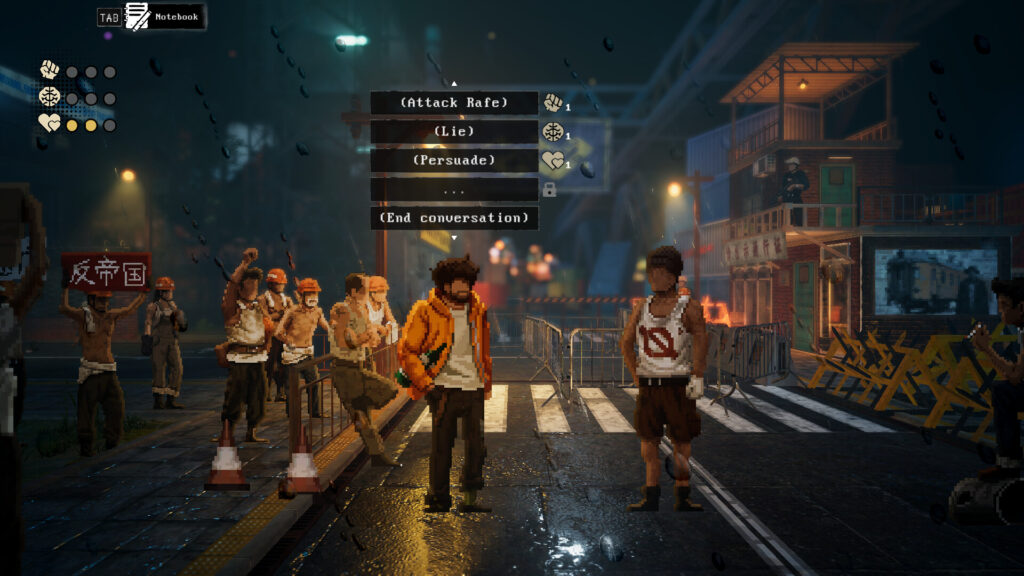
Lucas collects evidence and clues through good old detective work; he must interview many civilians, search for objects, and sometimes bend the law to reach his goal. Lucas has three skills he can call upon during dialogue choices: strength, spirit, or charm, but these are limited in their use. They can be recharged with consumables that can be either scavenged or purchased, and even increased with the right item.
The Gift of the Gab
Dialogue choices can also affect your relationships with people, leading to a branching narrative. You could do a convoluted quest to get the information you need, or you could just try violence for a confession. This could lead to a negative relationship with this character, whose defence may be vital later. You see a lot of investigations lead to a court of public opinion and mob justice, meaning you need to present the facts and sway the public in your favour.
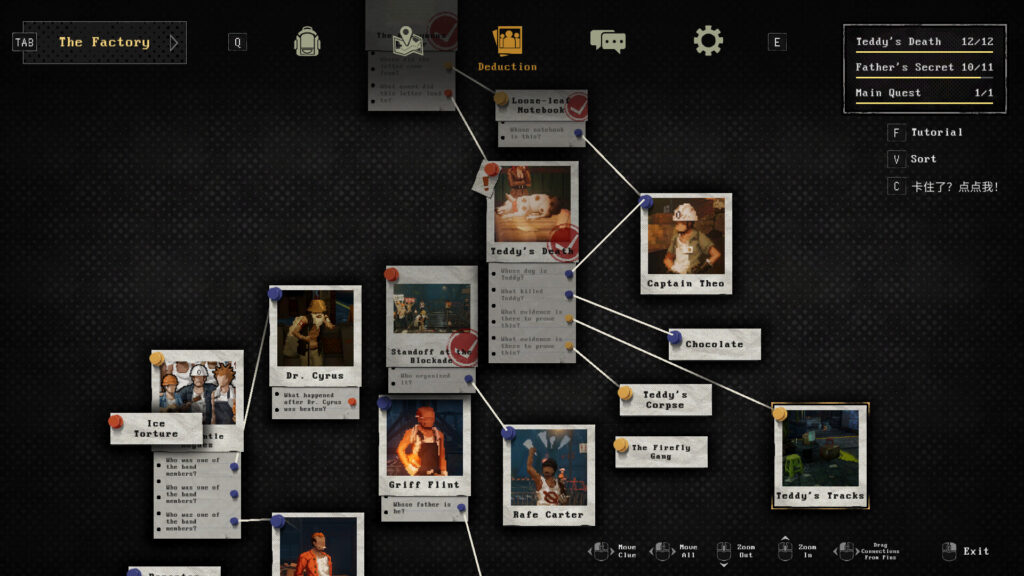
Lucas visualises the investigation in a mental evidence board where he can parse the clues together like polaroids and red string. An item may have questions tied to it like “Why is it here?” or “Whose is it?” and it’s up to the player to use the facts to connect the evidence. Luckily, a false assumption cannot be made, as a handy check mark appears when the correct answer is found.
You are not Alone
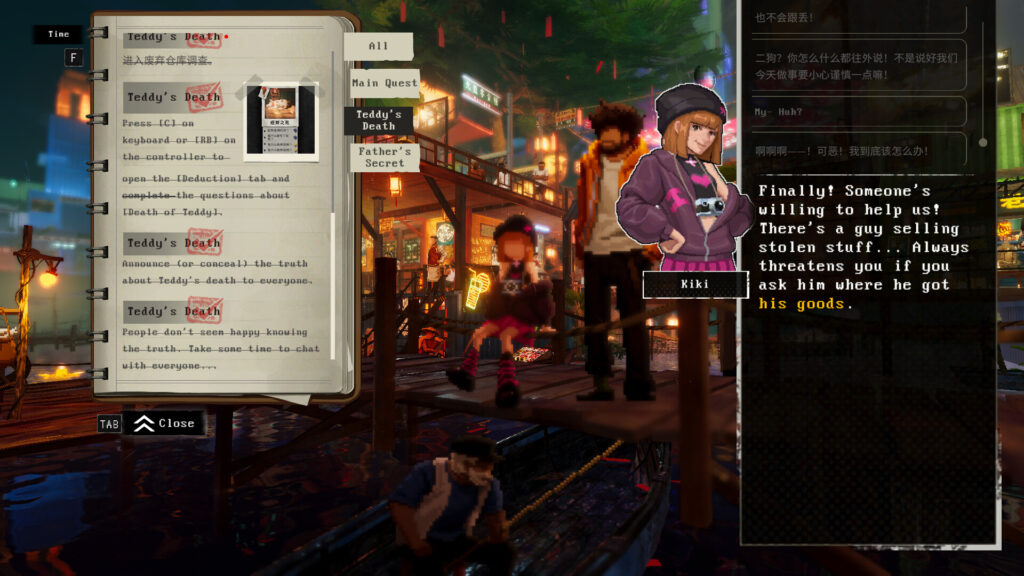
Lucas also recruits help, if somewhat reluctantly, from a couple of teenagers who help him create distractions or break into places from time to time. “The Shadow’s” power is also somewhat expanded later when it can rewind the effects on an object to a previous state.
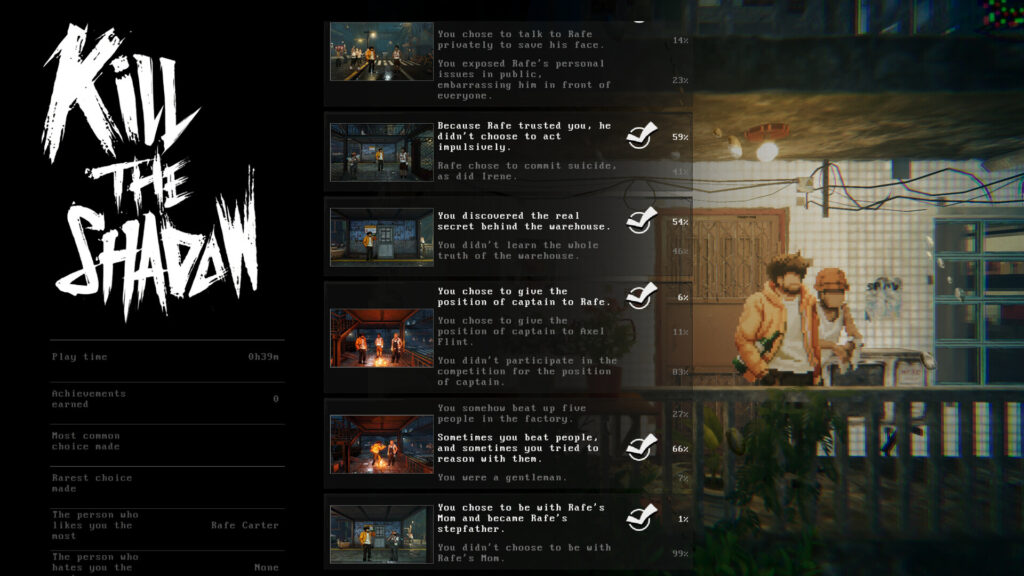
At the end of each act, the player’s choices are displayed and compared against the community’s choices, similar to a TellTale game. This is likely to encourage multiple playthroughs, as the game itself states that “not all investigations can be solved” in every timeline.
Every character is a 2D sprite but plonked in a 3D world. Each character is uniquely designed and wonderfully pixel-animated, with only a few background NPCs repeating. Sometimes the animation does some wacky stuff during the 2D-to-3D transition, with some characters walking backwards when walking at an angle, but mostly the effect holds up.
A 3D World
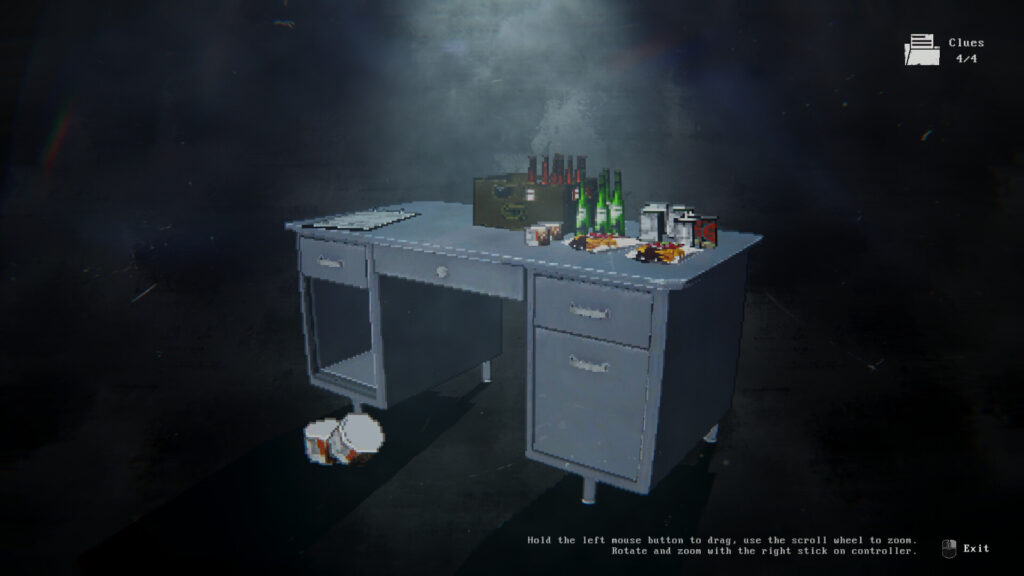
Sometimes, investigating will bring a 3D (if somewhat pixelated) model of the object, which can be manipulated to find clues or open compartments. The environment has a neon noir aesthetic, with run-down buildings contrasting with the bright lights of signs and a broken-down wharf next to a bustling nightlife.
The music is an odd mix of electronic and jazz that complements the noir musings, subtle enough not to draw your attention during text-heavy conversations. While Lucas has no voice actor, Kill The Shadow‘s other characters are partially voiced. This is often the first couple of lines of dialogue or sometimes a lengthy paragraph rephrased. The voice cast is small, though, and many of the actors pull multiple roles, often not changing their performances, which leads to multiple characters having the same voice.
A Problem with Localisation
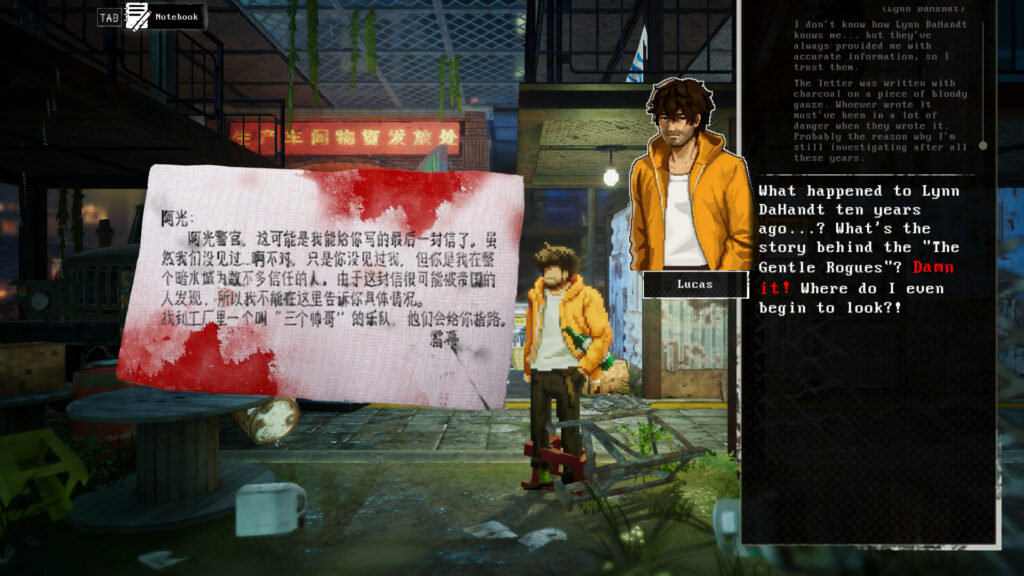
While Kill The Shadow was translated fully, it wasn’t necessarily localised very well. Some terms and descriptions were too culturally alien for me to understand, which meant I had an additional, always-present barrier that affected my overall progress and enjoyment of the title. I am fully aware this was a personal issue, but it always made me hesitant to return to the game. Some graphic assets, like notes, were also left untranslated.
Kill The Shadow was fully playable with either controller or keyboard. It also offers the option to play with the original voice language and includes a Twitch integration for chat to choose dialogue. After completion, you do get access to a branch storyline, where you can see the outcomes.
I did come across a few running errors. One fatal crash-to-desktop error wiped some progress, but thankfully, the auto-saves are pretty generous. I also managed to find one untranslated voiceline during my nine-hour playtime.
A BitterSweet End
There is also the AI-generated elephant in the room. The Steam page had an AI disclosure that has, at the time of writing, disappeared. While my research finds the dev just used tools to double-check the translation and “Store Page Assets”, there are some suspicious assets in-game that people should take at their own discretion.
While I did manage to finish and ultimately enjoyed the story, there was always a barrier to entry, and the early hours didn’t build enough intrigue to lay a solid foundation. A lot of the beats that hooked me came later on, and many players would have turned off way earlier. Kill The Shadow is a competent but flawed title, but the localisation barriers and slow start hold it back from greatness.

Developer: Shadowlight
Publisher: Phoenix Game
Platforms: PC
Release: 5 August 2026
Key provided by Press Engine
About the Author